Author: Site Editor Publish Time: 04-03-2026 Origin: Site
In the food packaging industry, we are in an unprecedented "green fog." Brands often face a dilemma: should they choose traditional plastics that go into blue recycling bins, or new biomaterials that claim to "dissolve in the soil"?
If they choose the wrong one, their brand may be branded as a "greenwasher."
Most articles will tell you they are defined differently, but we're talking about the truth of the infrastructure.
Recyclable: Its core lies in its circular potential. If your audience is in urban areas, a well-developed recycling system can give packaging a new lease on life. The logic is: 1 -> 0 -> 1.
Compostable: Its core lies in its biodegradability. But note that most food bags need "industrial composting," not your own backyard.
The logic is: 1 -> 0.
Why do some brands receive complaints for using recyclable bags, while others waste resources using compostable materials?
The "Fatal Flaw" of Greasiness and Residue: If your product is high in oil and has heavy residue (such as takeout containers or ready-to-eat soup packets), compostable materials are a death sentence. Plastic bags with food residue cannot enter the recycling chain; forced recycling will only contaminate the entire batch of raw materials.
The "optimal solution" for dry goods and snacks: For dry goods such as potato chips and nuts, high-barrier, single-material recyclable bags currently offer a better balance between cost and environmental friendliness.
Many brands blindly pursue compostability while neglecting barrier properties.
Traditional polyethylene (PE) can easily achieve high barrier properties through physical thickening, but early compostable materials had inherent weaknesses in moisture and oxygen protection.
Experts recommend: When choosing compostable packaging, always verify that it complies with EN 13432 or ASTM D6400 standards. Uncertified "degradability" is simply misleading.
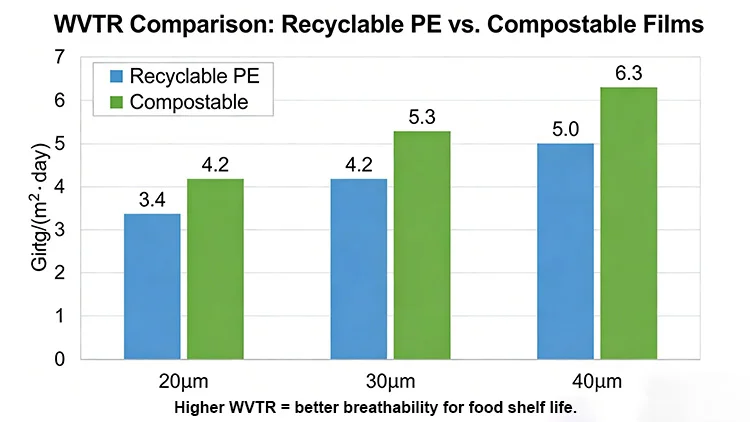
1. The "Hidden Killer" of Shelf Life: WVTR vs. OTR
Comparison Conclusion: Recyclable Mono-PE (monopolyethylene) still holds an overwhelming advantage in barrier properties.
Application Recommendations: If your product contains nuts, dry pet food, or frozen meat, Mono-PE is the preferred choice. Forcing a switch to compostable materials may cause the product to deliquinate or oxidize oils within its shelf life, leading to large-scale returns.
Reversal Scenario: Only when the product itself has a high moisture content and extremely fast turnover (such as fresh organic vegetables or bakery daily desserts) can the high permeability of compostable materials actually help prevent condensation buildup and delay mold growth.
Comparison Conclusion: Compostable materials (especially those containing PBAT) are generally softer and have a slightly milky white appearance, unlike highly transparent PE which clearly displays the original appearance of food.
Application Recommendations: For food products aiming for a "high-end visual transparency," insist on using recyclable materials; brands emphasizing a "natural, organic feel" can leverage the matte texture of compostable materials for differentiated marketing.
3. Hidden Costs: Heat Sealing Performance
Comparison Conclusion: Compostable materials are extremely sensitive to temperature.
Application Recommendations: On automated packaging lines, using compostable materials often requires lowering the sealing temperature and slowing down the line speed, which means your production efficiency may decrease by 15%-30%. This is a financial expense that many brands easily overlook before changing their packaging.