Author: Site Editor Publish Time: 24-06-2026 Origin: Site
In commercial manufacturing, Plastic Food Packaging acts as an engineered barrier system. It actively extends shelf life, prevents contamination, and withstands harsh supply chain transit. Getting this material choice right remains a critical business decision.
Selecting the wrong polymer compromises food safety. It triggers regional compliance violations and ultimately destroys brand trust. Conversely, over-engineering your package design erodes profit margins unnecessarily. Procurement teams must strike a delicate balance between functional performance and unit efficiency.
This guide provides a technical and functional framework. You will learn how to evaluate various plastic materials against specific food product requirements. We will explore how to match unique food profiles to the correct polymer structures. Additionally, we unpack barrier metrics, navigate complex regulatory baselines, and outline a clear logic for vetting reliable packaging suppliers.
Food distribution faces several core conflicts daily. Products must survive long spoilage timelines, resist transit damage, and maintain strict moisture control. When a product leaves the manufacturing floor, it enters a hostile environment. Temperature fluctuations, physical impacts, and prolonged storage challenge the product's integrity. The packaging must absorb these stresses entirely.
Successful packaging achieves three measurable success criteria. First, it delivers measurable shelf-life extension. Second, it guarantees zero chemical leaching under standard storage conditions. Third, it maintains strict unit-cost efficiency. Manufacturers cannot sacrifice one metric for another without jeopardizing the product's market viability.
Brands often over-prioritize consumer aesthetics. However, successful procurement requires shifting focus from branding to material science. Structural integrity dictates whether a container survives a warehouse drop. Tamper evidence protects public safety. Barrier properties decide if the food inside tastes fresh or stale upon opening. Form must strictly follow function.
Engineers categorize plastics using Resin Identification Codes (RIC). These standardized numbers indicate the specific polymer used. Each resin offers distinct commercial utility based on its molecular structure.
PET provides exceptional clarity and strong oxygen barrier properties. It resists impact well and handles cold storage efficiently. Because it keeps gases trapped, carbonation stays intact over long periods. Manufacturers rely on PET for beverage bottles, transparent salad domes, and peanut butter jars. Its transparency allows consumers to inspect the food visually before purchase.
HDPE features a densely packed molecular structure. This makes it opaque, highly rigid, and an excellent moisture barrier. It blocks light out, which prevents the rapid oxidation of certain liquids. You will commonly see HDPE used for milk jugs, opaque juice containers, and large bulk food storage tubs. It withstands heavy stacking in warehouse environments easily.
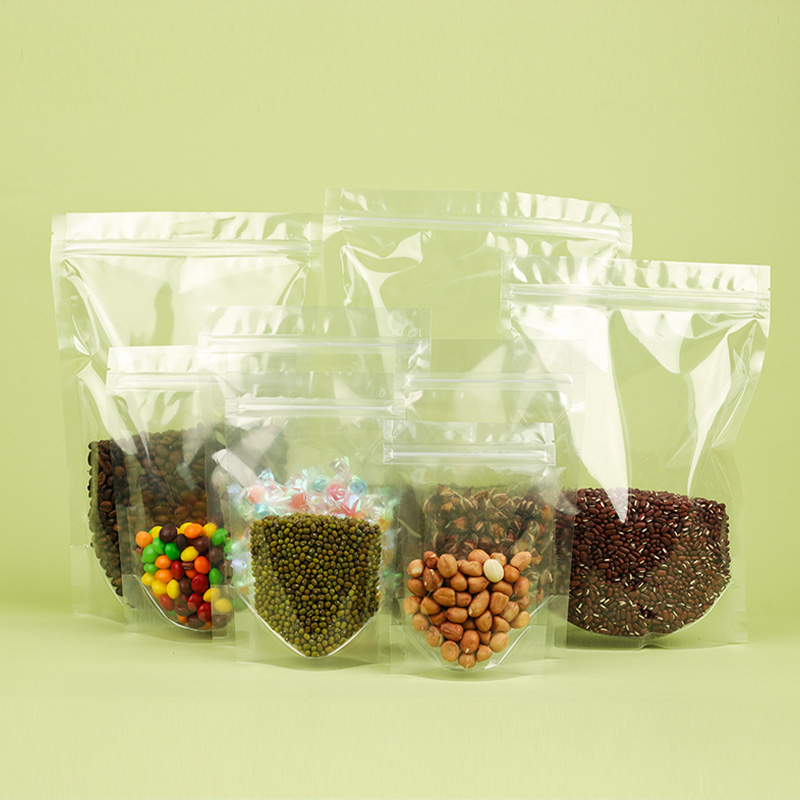
LDPE acts as the flexible workhorse of the packaging industry. It offers extreme toughness and remains highly heat-sealable. Even in sub-zero temperatures, it resists cracking. For flexible formats, producers rely heavily on LDPE to manufacture durable plastic food bags, frozen food films, and commercial shrink wraps. It securely contains irregularly shaped items without tearing.
PP boasts an incredibly high melting point. It also offers superb chemical resistance against greases and acids. Because it survives intense heat, PP dominates the hot-fill application sector. Commercial kitchens and manufacturers use it for microwavable takeout containers, hot-fill liquid bottles, and standard yogurt cups. It maintains its structural rigidity even when exposed to boiling temperatures.
Single polymers rarely solve every problem. Engineers create multi-layer films by sandwiching specialty plastics like EVOH or PVDC between structural layers. These engineered materials act as ultra-high-barrier films. They provide extreme shelf-life extension by virtually eliminating oxygen ingress. You will find them heavily used in vacuum-sealed fresh meats and modified atmosphere packaging (MAP) for sensitive perishables.
| Resin (RIC) | Key Property | Ideal Food Profile | Common Application |
|---|---|---|---|
| PET (1) | High clarity, Gas barrier | Beverages, Cold deli items | Water bottles, Salad domes |
| HDPE (2) | Opaque, Moisture barrier | Light-sensitive liquids | Milk jugs, Bulk tubs |
| LDPE (4) | Flexible, Heat-sealable | Frozen goods, Dry snacks | Flexible food bags, Shrink wrap |
| PP (5) | High heat tolerance | Hot-fill, Greasy foods | Microwavable containers |
Selecting materials requires analyzing the unique degradation profile of your food product. You must align the polymer’s capabilities against the specific threats the food faces during transit and storage.
Engineers measure barrier performance using Oxygen Transmission Rate (OTR) and Moisture Vapor Transmission Rate (MVTR). Dry goods like potato chips demand incredibly low MVTR to prevent staleness. Conversely, raw meats require highly specific OTR levels to maintain a desirable red color without accelerating bacterial growth. Calculating these necessary barriers dictates whether a simple PE film suffices or if an advanced EVOH layer becomes necessary.
Common Barrier Requirement Chart:
| Product Category | OTR Priority (Oxygen) | MVTR Priority (Moisture) |
|---|---|---|
| Roasted Coffee | Critical (Prevents staling) | High (Keeps beans dry) |
| Fresh Produce | Moderate (Needs respiration) | Moderate (Prevents condensation) |
| Crispy Snacks | Low to Moderate | Critical (Prevents sogginess) |
| Raw Meat | Critical (Controls bacteria) | Critical (Prevents freezer burn) |
Evaluate materials against expected environmental extremes. Products undergoing freeze-thaw cycles need polymers that will not embrittle and shatter in sub-zero warehouses. Alternatively, hot-fill assembly lines dump liquids at near-boiling temperatures directly into the package. PP handles this stress seamlessly, while standard PET would warp instantly. You must also account for end-user behaviors, such as microwave heating.
Foods aggressively interact with their surrounding environments. Highly acidic items like tomato sauce or citrus juices can degrade improper polymers over time. Similarly, lipids (fats) found in oils and cheeses can migrate into certain plastics, compromising the package's structural integrity. Assessing this chemical compatibility prevents dangerous material breakdowns.
Procurement teams must decide between rigid containers and flexible films. Flexible pouches significantly reduce storage footprint and slash shipping weight costs compared to heavy rigid jars. However, rigid containers offer superior crush resistance. You must weigh logistics savings against required physical protection.
Food safety compliance is not static. Regulatory agencies hold manufacturers strictly accountable for the chemical stability of their packaging. Ignorance of these frameworks leads to costly recalls.
In the US, the FDA tightly regulates "food contact substances" (FCS). Any material touching food must meet stringent safety criteria or fall under Generally Recognized as Safe (GRAS) standards. The EU relies on the European Food Safety Authority (EFSA) to govern these identical concerns. Both bodies demand exhaustive proof that packaging materials will not render food unsafe for human consumption.
Polymers can shed molecules into food. Regulators police this using Overall Migration Limits (OML) and Specific Migration Limits (SML). OML measures the total amount of non-volatile substances transferred to food. SML restricts the migration of specific, potentially toxic chemicals. Heat and long-term acidic exposure drastically accelerate migration. You must ensure your chosen plastic remains well below these legal thresholds under worst-case scenarios.
Never rely on verbal assurances from suppliers. Always demand verifiable documentation before running a production line.
Procurement teams currently face immense pressure to adopt sustainable materials. However, balancing functional performance against emerging recyclability mandates introduces severe implementation risks.
The highest-performing barrier plastics utilize multi-layer films. Combining PE, EVOH, and PET creates an impenetrable fortress against oxygen and moisture. Unfortunately, recycling facilities cannot easily separate these fused layers. The best materials for food preservation are historically the hardest to recycle. Shifting away from them risks slashing your product's shelf life dramatically.
Using Post-Consumer Recycled (PCR) resins in direct food contact presents unique dangers. Virgin plastics guarantee chemical purity. PCR plastics inherently carry contamination risks from their previous lifecycles. Furthermore, recycling degrades the polymer chain, resulting in structural weaknesses. If you implement PCR, you must ensure it undergoes a certified super-cleaning process approved by regulatory bodies for direct food contact.
Switching from non-recyclable to recyclable plastics triggers hidden operational costs. Recalibrating sealing machines to handle new melt temperatures eats up engineering hours. New mono-materials often run at slower line speeds, reducing daily output. Additionally, you must fund entirely new accelerated shelf-life testing protocols to validate the new material. Prepare your budgets for these invisible transitions.
Sourcing exceptional packaging requires thoroughly vetting the manufacturer behind the material. Treat them as a technical partner, not just a commodity vendor.
Does the supplier offer robust in-house testing? They should possess the laboratory equipment necessary to test barrier performance (OTR/MVTR) and conduct simulated chemical migration studies. If they outsource all technical testing, they cannot rapidly iterate on custom solutions for your specific food profile.
Ask suppliers to trace their resin sourcing. Consistent barrier performance relies entirely on consistent raw materials. If a supplier constantly switches resin brands to save pennies, your packaging will suffer from unpredictable sealing failures and fluctuating clarity. Demand complete supply chain transparency.
Evaluate a supplier's willingness to provide small sample runs. You must conduct real-world shelf-life testing before committing to massive volumes. Suppliers who refuse prototyping force you into blind, high-risk investments.
Initiate a pilot test. Select 2-3 shortlisted materials from your vetted supplier. Run these variants alongside rigorous accelerated aging tests to gather empirical data on moisture retention and flavor stability. Let the data drive the final procurement decision.
Selecting optimal packaging represents a critical material science decision. It dictates the long-term viability and safety of your product. You cannot treat this process as a simple procurement line item.
To succeed, you must precisely match specific polymers—whether PET, PP, or LDPE—to the exact thermal, chemical, and environmental stresses your food faces. A rigid jar solves different problems than flexible pouches do. Overlooking these functional necessities leads to rapid spoilage and costly recalls.
Moving forward, prioritize supplier transparency above all else. Demand rigorous compliance documentation, secure Letters of Guaranty, and insist on comprehensive migration testing. Choosing verifiable safety and engineered performance over the lowest unit cost guarantees your brand’s reputation remains intact.
A: Polypropylene (PP), identified by RIC 5, is the safest choice for hot foods. It boasts an exceptionally high melting point and remains chemically stable at elevated temperatures. This prevents the plastic from warping or leaching harmful chemicals into the food during hot-fill processes or microwave heating.
A: No. Standard plastics can embrittle and shatter in sub-zero environments. Low-Density Polyethylene (LDPE) is preferred for freezer bags because it maintains excellent low-temperature flexibility. This prevents cracking, ensuring the barrier remains intact to protect food from severe freezer burn.
A: Food grade plastic strictly refers to materials that comply with FDA or EFSA regulations for direct food contact. It guarantees the absence of non-approved industrial dyes, recycled contaminants, and harmful plasticizers that could migrate into food and pose human toxicity risks.
A: Multi-layer plastics combine the strengths of different polymers. For example, combining structural PE with a specialized EVOH layer blocks both moisture and oxygen simultaneously. This dual-barrier approach exponentially extends the perishable timelines of sensitive foods like fresh meats and roasted coffee.