Author: Site Editor Publish Time: 09-06-2026 Origin: Site
Brand owners face a constant struggle when launching new animal nutrition lines. You must perfectly balance product preservation, operational machinability, and undeniable shelf impact. Finding the best format is never about choosing a single universally superior material. Instead, it requires a calculated alignment between your food's specific formulation, stringent shelf-life requirements, and overall business objectives.
Factors like internal moisture levels and applied fat content completely dictate these material choices. We must move beyond generic marketing claims to focus on what truly matters to your bottom line. Your long-term success relies heavily on technical barrier properties, strict compliance realities, and practical implementation trade-offs on the factory floor.
This guide will show you exactly how to navigate these technical complexities. You will learn how to match formulations to specific barrier films safely. We will also help you evaluate structural formats and qualify your vendors based on objective, hard data. By understanding these core dynamics, you can protect your product while satisfying modern consumer demands seamlessly.
Dry kibble typically contains significant fat levels that pose major preservation challenges. Brands increasingly add sensitive Omega-3 fatty acids to improve coat health. You must focus intensely on grease resistance and oxidation prevention. If fats oxidize, the kibble goes rancid very quickly. This ruins palatability and instantly destroys consumer trust.
High-fat diets require specialized multi-layer laminations to block oxygen ingress completely. Furthermore, you face severe mechanical challenges during automated filling and bulk transport. Kibble pieces often feature sharp, highly irregular edges. Combined with heavy fill weights in large bulk bags, these edges threaten to puncture standard films. You must specify materials featuring exceptionally high puncture resistance. We highly recommend testing drop impacts across freezing temperatures. This guarantees the bags do not shatter or fail during harsh winter transit.
Wet foods introduce an entirely different set of complex technical demands. You must carefully evaluate modern retort pouches against traditional metal cans. Metal cans offer unmatched rigidity but suffer from terrible freight weights. Pouches provide immense spatial savings and modern consumer appeal. However, they demand extraordinary thermal stability.
The pouch material must withstand aggressive high-heat retort sterilization processes, often exceeding 121°C. It absolutely cannot delaminate or lose seal integrity under immense pressure. You must maintain a strict anaerobic environment inside the package to prevent botulism. Absolute moisture retention is equally critical for semi-moist foods. If the barrier fails even slightly, the product dries out or spoils prematurely.
Treats and health supplements serve distinct consumer usage occasions. Buyers access these products frequently over several weeks. Therefore, you must prioritize consumer convenience and functional resealability. A simple one-time tear notch simply will not suffice for premium lines.
We advise a thorough evaluation of resealable zipper technologies. Press-to-close zippers offer cost-effective moisture protection for standard daily treats. Slider zippers provide a premium, effortless experience for expensive senior dog supplements. Both options prevent premature staling after the initial opening phase. They also keep pungent meat odors contained effectively inside the bag. You should carefully match the chosen zipper profile to the specific powder or chunk size of your product to prevent track clogging.
The industry continues a massive, irreversible shift away from heavy rigid formats. You can achieve substantial freight and warehouse density advantages using flexible structures. Rigid tubs and metal tins ship mostly empty air before reaching your filling lines. In contrast, pet food packaging bags ship completely flat on compact pallets. This dramatically lowers inbound transportation emissions and overall logistics complexity.
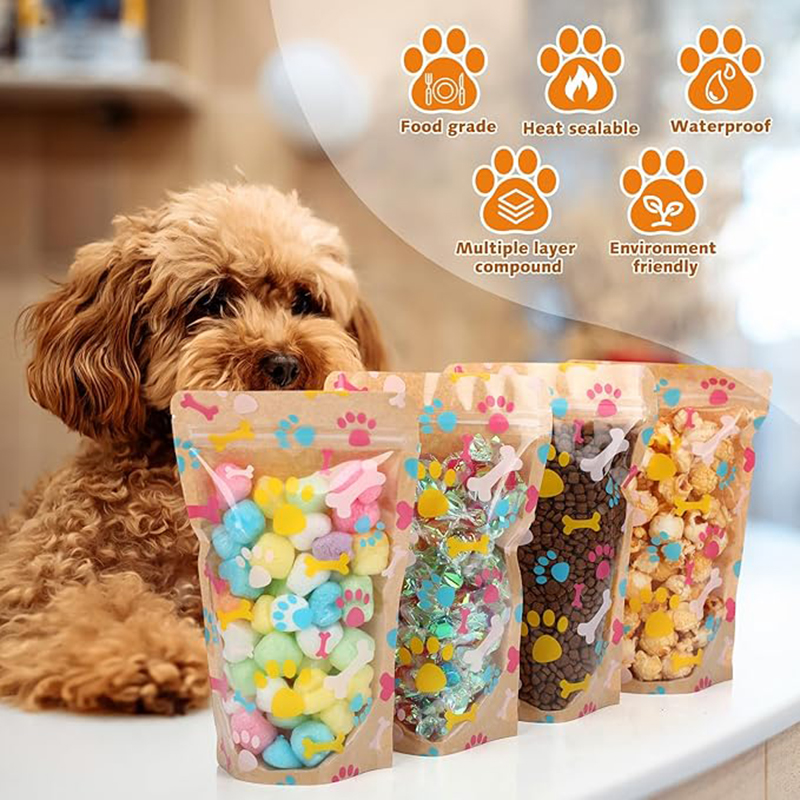
You must select the right structural configuration for your specific brand identity. Stand-up pouches (SUP) work beautifully for small treat volumes under two pounds. Flat-bottom bags offer excellent vertical stability for mid-weight products on retail shelves. Quad-seal bags provide four distinct, crisp panels for premium billboard branding. These advanced configurations allow your graphics to pop in crowded retail aisles. They also maximize internal volume efficiency perfectly.
Flexible formats rely heavily on sophisticated material laminations to protect the contents. Manufacturers typically utilize robust multi-layer structures like PET/ALU/PE. The outer PET (Polyester) layer accepts high-quality printing and resists physical scuffing. The middle aluminum foil layer provides an absolute, uncompromising barrier. It protects against UV light, oxygen, and moisture perfectly. The inner PE (Polyethylene) layer acts as the vital heat-sealant web.
However, many marketing teams desire clear windows to showcase the food visually. This creates a difficult trade-off between product visibility and chemical preservation. Clear windows inherently eliminate the protective foil layer in that specific zone. This exposes the food to harmful UV degradation immediately. UV light quickly breaks down sensitive vitamins and natural fats. If you require a window, you must apply specialized clear barrier coatings like AlOx or SiOx to mitigate this damage.
Never base your vendor selection solely on aesthetic printing capabilities. You must objectively define acceptable barrier thresholds based on your target shelf life. Two crucial metrics rule this qualification process: Oxygen Transmission Rate (OTR) and Water Vapor Transmission Rate (WVTR).
You must demand verified post-conversion testing data from your suppliers. Theoretical barrier data derived from flat, raw film rolls is practically useless. The mechanical conversion process introduces sharp folds, gussets, and heat seals. These intense physical actions can degrade the initial barrier significantly.
Here is a benchmark chart for typical target transmission metrics:
| Product Category | Target OTR (cc/m2/day) | Target WVTR (g/m2/day) | Primary Preservation Goal |
|---|---|---|---|
| Standard Dry Kibble | < 5.0 | < 5.0 | Prevent oxidation & staling |
| High-Fat/Premium Diet | < 1.0 | < 1.0 | Stop rapid rancidity |
| Semi-Moist Treats | < 3.0 | < 1.5 | Retain internal moisture |
| Retort Wet Food | < 0.1 | < 0.1 | Absolute commercial sterility |
Your selected structure must survive a brutal, highly variable supply chain journey. You must ensure absolute structural integrity during automated palletization, rough transit, and modern e-commerce fulfillment. E-commerce shipping proves particularly harsh on heavy flexible bags. Products face multiple severe drops before ever reaching the consumer's porch.
You should conduct rigorous drop testing from various heights onto solid concrete. Burst testing is also strictly necessary to evaluate atmospheric pressure changes during air freight. You must carefully evaluate overall seal strength and flex-crack resistance. Microscopic pinholes caused by flex-cracking will instantly destroy the internal modified atmosphere, rendering the barrier useless.
Even the highest-rated barrier film fails if it cannot run efficiently. You must precisely assess how the film interacts with your existing Form-Fill-Seal (FFS) equipment. Two physical properties matter most here: surface slip and film stiffness (modulus).
The coefficient of friction (COF) dictates the film's slip properties. Too much friction causes the film to jam violently in the forming collar. Too little friction makes the heavy bags slide recklessly off the exit conveyors. Stiffness ensures the bag stands up properly during the high-speed filling cycle. Work closely with your machine operators to dial in these exact specifications before ordering.
Modern consumers actively demand greener solutions for their animal companions. The industry is rapidly moving away from unrecyclable mixed-plastic structures. Traditional PET/PE structures cannot be recycled easily due to differing polymer melting points. Instead, forward-thinking brands are transitioning to innovative mono-material structures.
These advanced structures utilize only Polyethylene (PE) or Polypropylene (PP). Because they use a single polymer family, they qualify for store-drop-off recycling programs. Implementing this transition for your Pet Food Packaging demonstrates true environmental commitment. Suppliers increasingly use Machine Direction Oriented (MDO) PE to mimic the stiffness of traditional PET. However, adopting these materials requires significant technical planning to execute correctly.
You must acknowledge the inherent manufacturing risks of adopting mono-materials. These modern films inherently lack the high heat resistance of traditional PET layers. During the sealing phase, the outer printed layer often melts before the inner layer bonds correctly.
This thermal limitation creates a dangerously narrow heat-sealing window. You face a high risk of cosmetic seal distortion or complete burn-through. To avoid these catastrophic failures, you must adapt your production lines proactively. This highlights the absolute necessity of equipment retrofits, such as specialized Teflon coatings on seal jaws. Alternatively, you may need to accept slower run speeds to control heat application precisely.
Adding Post-Consumer Recycled (PCR) content further boosts your overall sustainability profile. However, you face immense compliance hurdles regarding direct food contact. Chemical impurities in recycled resins can easily migrate into the food.
FDA regulations heavily restrict using standard PCR in direct food-contact layers. You must utilize PCR safely by embedding it strictly in the outer structural layers. The inner sealant web touching the food must remain 100% pure virgin resin. This specific multi-layer extrusion strategy protects the animal perfectly while reducing virgin plastic consumption.
Navigating the complex regulatory landscape is completely non-negotiable for brand survival. You must ensure absolute adherence to FDA and USDA regulations. These bodies strictly govern all food-contact materials operating in the market. You must also comply with the Food Safety Modernization Act (FSMA) requirements regarding preventative controls.
Additionally, you should align heavily with GFSI (Global Food Safety Initiative) standards. GFSI certification proves your supply chain maintains rigorous hygiene protocols consistently. Your packaging vendors must hold active certifications like SQF, BRC, or FSSC 22000. Never purchase raw materials from unverified facilities lacking these fundamental safety baselines.
High-fat animal foods act as aggressive chemical solvents over extended periods. They can actively pull harmful compounds out of the packaging layers. Therefore, you must conduct comprehensive migration testing before commercial launch.
This testing verifies that printing inks, lamination adhesives, and substrate chemicals stay put. They absolutely must not leach into the food during its intended shelf life. You should test these materials under extreme temperature conditions to simulate harsh warehouse storage. We advise utilizing only low-migration inks and solvent-less lamination adhesives for these highly specific applications.
Robust traceability protocols protect your brand during rare but devastating recall events. You must meet specific printing and coding requirements on every single manufactured unit.
Follow these essential practices for highly reliable coding:
Proper traceability guarantees you can isolate defective batches rapidly. This minimizes financial damage and protects vulnerable animals efficiently.
Selecting the perfect packaging format requires a rigorous, highly data-driven methodology. You must first map the specific formulation risks, focusing primarily on internal moisture and fat levels. Next, accurately define the precise OTR and WVTR barrier requirements needed to achieve your target shelf life. Then, you can safely select the most efficient physical format for your specific distribution model. Finally, always test the material's physical machinability on your actual production equipment.
We recommend several immediate next steps for your procurement and product teams. First, request detailed material spec sheets and official compliance certificates from all potential vendors. Second, initiate small pilot runs using unprinted rollstock to verify sealing windows dynamically. Third, conduct accelerated shelf-life testing in climate-controlled chambers. Complete these crucial validations before ever committing to large Minimum Order Quantities (MOQs). By following this disciplined approach, you ensure product safety, protect your profit margins, and delight consumers consistently.
A: Sustainable materials, like mono-PE or compostable films, often exhibit a slight reduction in barrier properties compared to traditional aluminum foil laminates. This can potentially shorten shelf life by allowing faster oxygen or moisture ingress. To mitigate this risk, brands apply advanced transparent barrier coatings like EVOH or AlOx. These enhance protection significantly while maintaining recyclability.
A: OTR stands for Oxygen Transmission Rate. It measures how much oxygen passes through the film, which is critical for preventing fat rancidity in dry kibble. WVTR stands for Water Vapor Transmission Rate. It measures moisture transfer, which prevents dry foods from becoming soggy and keeps semi-moist treats from drying out prematurely.
A: Yes, but it almost always requires modifications. Mono-materials lack a heat-resistant outer layer, making them highly prone to stretching or burn-through during sealing. You will likely need to adjust your temperature profiles, slow down the line speed, or invest in tooling upgrades like specialized Teflon-coated seal jaws for precise heat distribution.
A: Minimum Order Quantities depend heavily on the chosen printing technology. Traditional rotogravure printing requires manufacturing custom metal cylinders, demanding MOQs of 10,000 to 30,000 pouches per SKU. Conversely, modern digital printing requires no physical setup plates, allowing for much lower MOQs ranging from 1,000 to 5,000 units. Digital is ideal for pilot launches.