Author: Site Editor Publish Time: 10-06-2026 Origin: Site
Premium pet nutrition formulations demand a highly engineered physical barrier. High-quality packaging serves as this critical technical shield. It actively prevents fat oxidation and extends product shelf life. It also aggressively protects your brand equity on competitive retail shelves. Modern brands face constant tension between maintaining these exceptional barrier properties and managing tight supply chain budgets. At the same time, consumers increasingly demand sustainable material options. This evolving landscape complicates traditional manufacturing choices. Choosing incorrectly often leads to catastrophic retail returns. Failed materials instantly ruin hard-earned customer trust. This comprehensive guide provides a detailed technical and commercial framework. We designed it specifically for procurement and product teams. You will learn exactly how to evaluate critical material properties. You will also discover how to confidently specify the right substrates to protect your formulations and secure your market share.
Formulating high-quality pet food requires immense capital investment. However, placing superior kibble inside inadequate packaging destroys this value quickly. Poor material selection leads directly to product rancidity. It also invites dangerous pest infestations during transit or warehousing. Retailers swiftly reject compromised shipments. These rejections result in catastrophic commercial returns and severely damage retail relationships. You must establish rigorous engineering criteria to evaluate your packaging success.
Procurement teams evaluate materials using four core metrics. Each metric directly influences product safety and operational efficiency.
Packaging engineers rely on specific polymer families to build robust barrier systems. Each substrate performs a highly specialized function within the final product. Understanding these foundational materials helps you make informed procurement decisions. They form the building blocks of every high-performance bag.
Manufacturers typically use PET as the outermost layer of the pouch. It offers excellent heat resistance during the sealing process. PET also provides outstanding dimensional stability. It does not stretch or distort easily under tension. Most importantly, it delivers superior printability. Brands rely on PET to showcase high-definition graphics and complex color gradients.
Polyethylene serves as the inner structural and sealant layer. It directly touches the pet food. PE is inherently food-safe and chemically inert. It features excellent weldability. This allows manufacturing lines to create incredibly strong, hermetic seals. PE also provides the necessary bulk and thickness to support heavy product volumes.
Polypropylene often acts as an outer or middle layer. It offers an excellent inherent moisture barrier. It remains highly cost-effective for large-scale production runs. Brands frequently choose BOPP (Biaxially Oriented Polypropylene) to achieve a premium matte finish. It also offers excellent transparency for product-viewing windows.
These materials serve as the ultimate barrier layers. Aluminum foil completely blocks 100% of light, oxygen, and moisture. VMPET involves depositing a thin layer of aluminum molecules onto a PET film. Manufacturers use these intensive barriers for premium, high-fat, or freeze-dried pet foods. They guarantee maximum shelf life under harsh retail conditions.
| Substrate Type | Primary Function | Key Advantage |
|---|---|---|
| PET | Outer print layer | High heat resistance and HD printability |
| PE (LLDPE) | Inner sealant layer | Food-safe, strong hermetic seals |
| PP (BOPP/CPP) | Outer/Middle layer | Excellent moisture barrier, matte finish options |
| Aluminum / VMPET | Core barrier layer | Maximum oxygen and light blockage |
Material science dictates a harsh reality. No single material can offer premium printability, maximum gas barrier, and reliable heat-sealing properties simultaneously. Structural architecture solves this limitation. Engineers combine different polymer films using industrial adhesives. A well-designed laminated pet food bag effectively merges the best properties of multiple substrates into one unified system.
Most commercial packaging utilizes a 3-ply or 4-ply anatomical structure. The outer layer receives the printed ink and resists external scuffing. Engineers typically specify PET or BOPP for this exterior face. The middle layer handles barrier protection. Depending on the product's fat content, this involves Aluminum, VMPET, or Nylon. Nylon specifically provides extreme puncture resistance for sharp bone-in treats. The inner layer ensures food-contact safety. It relies on LLDPE to melt seamlessly and create airtight closures.
However, lamination carries distinct implementation risks. Low-tier manufacturers sometimes rush the adhesive curing process. Rushed curing leaves residual solvents trapped between the film layers. These solvents can migrate into the pet food and alter its flavor profile. Poor lamination also causes structural delamination. The layers physically separate under stress, compromising the entire barrier system. You must require your vendors to maintain strict curing protocols in temperature-controlled facilities.
Different pet food formats demand entirely different packaging architectures. You cannot use a universal material specification across your entire product portfolio. Matching the substrate combination to the product format prevents premature spoilage. It also optimizes your procurement spending.
Large format dry kibble requires extreme structural integrity. The primary requirements include high tensile strength, burst resistance, and aggressive grease barriers. Heavy bags endure severe mechanical stress during palletization. A typical robust structure utilizes PET / NY (Nylon) / PE. The Nylon acts as a shock absorber. For extreme durability in agricultural supply chains, brands evaluate woven polypropylene (WPP) laminated to an outer BOPP layer.
Wet food packaging must survive intense thermal processing. Manufacturers sterilize these products in massive autoclaves. The pouches must withstand high heat and pressure exceeding 121°C. Standard polyethylene melts under these conditions. A typical retort structure uses PET / AL / CPP. Cast Polypropylene (CPP) easily survives retort sterilization temperatures. It replaces standard PE to maintain seal integrity during cooking.
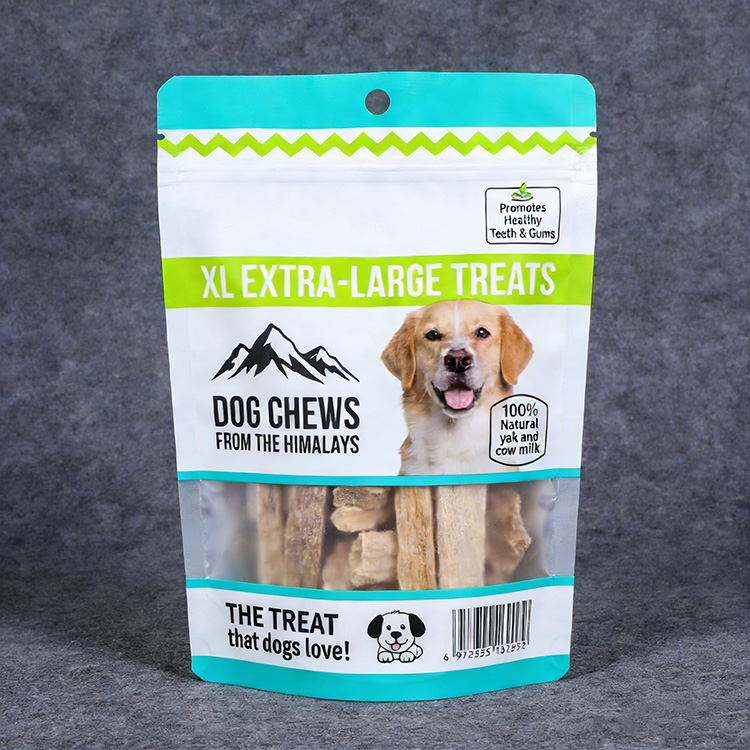
Freeze-dried products lack natural moisture. They act like sponges if the packaging barrier fails. Their primary requirement involves a maximum moisture barrier. Consumers also demand premium re-sealability via integrated zippers. A typical premium structure features Matte BOPP / VMPET / PE. The VMPET blocks moisture vapor transmission. The Matte BOPP provides an upscale, tactile feel for boutique retail shelves.
| Product Category | Critical Requirement | Optimal Material Structure |
|---|---|---|
| Dry Kibble (10kg+) | Burst resistance, tensile strength | PET / Nylon / PE or WPP+BOPP |
| Wet Food (Retort) | Thermal resistance (121°C+) | PET / Aluminum / CPP |
| Freeze-Dried Treats | Extreme moisture barrier | Matte BOPP / VMPET / PE |
Consumer pressure heavily drives the mono-material trend. Traditional laminates mix different plastic families together. Recycling facilities cannot separate a PET/AL/PE structure. Therefore, the industry is aggressively shifting toward 100% PE or 100% PP structures. These mono-materials comply with "Recycle Ready" and "Store Drop-off" environmental initiatives. They offer a unified chemical composition.
However, product developers must acknowledge the trade-off reality. Mono-materials inherently possess lower oxygen and moisture barriers compared to traditional foil-backed laminates. Upgrading to sustainable Pet Food Packaging involves distinct compromises. Removing the metal layer exposes high-fat kibble to faster oxidation.
To bridge this performance gap, material scientists introduced advanced current solutions. They integrate EVOH (Ethylene Vinyl Alcohol) coatings directly into the PE films. EVOH acts as an invisible, high-performance oxygen barrier. It boosts barrier performance significantly. Because it represents a tiny percentage of the total weight, it does not sacrifice recyclability.
Brands must adopt a skeptical lens during this transition. We strongly advise conducting rigorous accelerated shelf-life testing. Never roll out sustainable materials blindly. You must validate the EVOH barrier performance against your traditional laminate baselines. Rushing sustainable packaging without safety validation often compromises pet food safety.
Selecting the correct manufacturing partner is equally important as selecting the material. A premium laminate design fails if the factory cannot execute it precisely. You must audit potential vendors using strict, evidence-based criteria. A reliable partner acts as an extension of your quality assurance department.
Apply the following evaluation framework when assessing new suppliers:
Pet food packaging functions as a highly engineered physical barrier system. It actively defends your product against oxygen, moisture, and supply chain abuse. The strategic choice between standard foil laminates and sustainable mono-materials requires careful analysis. This decision depends strictly on your product's internal fat content, your distribution model, and your required shelf-life span. Choosing materials based solely on aesthetics invites product failure.
Your next step requires active technical validation. We encourage buyers to formally request technical data sheets (TDS) from potential manufacturing partners. Review the exact oxygen and moisture transmission rates. Furthermore, always request unprinted sample film rolls. Run extensive mechanical line trials on your own filling equipment before committing to full-scale commercial production.
A: Raw WPP bags are generally not safe for direct, high-fat food contact. They require a dedicated food-grade inner liner or an internal lamination layer. This inner barrier prevents biological contamination. It also stops internal fats and greases from leaking through the woven exterior fabric.
A: Traditional multi-material laminates like PET/AL/PE are generally not recyclable. Local facilities cannot separate the fused plastic and metal layers. This limitation drives the entire industry toward innovative mono-material PE/PE or EVOH-coated structures, which qualify for store drop-off recycling programs.
A: A standard 15kg bag typically ranges from 120 to 150 microns in total thickness. The thickness must scale proportionally with the product weight. Thinner structures lack the mechanical tensile strength required to prevent sudden drop-test failures during transit.
A: This external greasiness indicates severe material failure. It specifically points to an inadequate grease barrier layer within the substrate. It can also result from micro-punctures. These defects allow lipid migration, where internal product oils bleed directly through the packaging to the exterior.