Author: Site Editor Publish Time: 12-06-2026 Origin: Site
Sourcing commercial food packaging requires a delicate balance. You must manage operational unit economics, ensure strict food safety compliance, and maintain excellent brand presentation. Blindly selecting a manufacturer based on the lowest per-unit quote often backfires. Buyers frequently encounter hidden tooling costs, inconsistent quality like seal failures in custom plastic food bags, or serious compliance liabilities. These missteps can trigger costly product recalls and severely damage consumer trust.
To protect your brand, you need a standardized, skeptical evaluation framework. This guide helps you vet materials, audit manufacturers, and structure ironclad purchase agreements before committing to high-volume production. You will learn exactly what regulatory documents to request, how to match material properties to your specific operational needs, and how to avoid costly delays. Let us explore the critical steps to secure reliable suppliers and safeguard your food products.
Your primary objective is eliminating manufacturers posing legal or recall risks. Sourcing Plastic Food Packaging demands uncompromising attention to safety data. You simply cannot rely on verbal assurances from factory sales representatives.
Always request current material safety data sheets (MSDS) or regional equivalents. These documents must explicitly state FDA approval for direct food contact. Furthermore, look beyond the material itself and evaluate the manufacturing facility. Demand to see Global Food Safety Initiative (GFSI) recognized certifications. Acceptable benchmarks include BRC, SQF, and FSSC 22000. These specific certifications prove the factory strictly maintains hygiene, conducts regular pest control, and limits foreign object contamination during the extrusion and forming processes.
Plastics chemically interact with their contents over time. You must ensure the polymer does not leach harmful chemicals into the food. Ask the supplier for independent, third-party lab results proving successful migration testing. Different foods react very differently to polymers. Highly acidic foods like tomato sauces, high-fat items like butter, and hot-fill liquids pose unique leaching risks. Testing laboratories use chemical simulants like acetic acid or ethanol to replicate these harsh conditions. Ensure the test data accurately mirrors your actual product formula.
Rapid recall management saves brands from financial ruin. Ensure your supplier utilizes a documented lot-tracking system. If a specific batch of raw resin contains defects, they must isolate the affected containers immediately. Ask them how they manage mock recalls. If a supplier cannot trace a finished container back to its original resin batch within four hours, they pose an unacceptable risk.
Selecting the wrong polymer guarantees supply chain disasters. Your objective is preventing functional failures during transport, long-term storage, or end-user consumption. You must evaluate plastics against their real-world journey.
Will your customer microwave the container? Does it sit in a commercial freezer for six months? You must choose the substrate accordingly. Different plastics possess radically different thermal tolerances. Evaluate them strictly against your actual use cases rather than pure aesthetic clarity.
| Material | Abbreviation | Thermal Properties & Ideal Use Case |
|---|---|---|
| Polyethylene Terephthalate | PET | High clarity, excellent for cold storage and deli displays. Warps under high heat; not microwave-safe. |
| Polypropylene | PP | High heat resistance. Perfect for microwave use, hot-fill applications, and takeout meals. |
| High-Density Polyethylene | HDPE | Tough and opaque. Excellent moisture barrier for milk jugs and bulk condiment storage. |
| Low-Density Polyethylene | LDPE | Highly flexible. Maintains strength at freezing temperatures; ideal for frozen foods and squeeze bottles. |
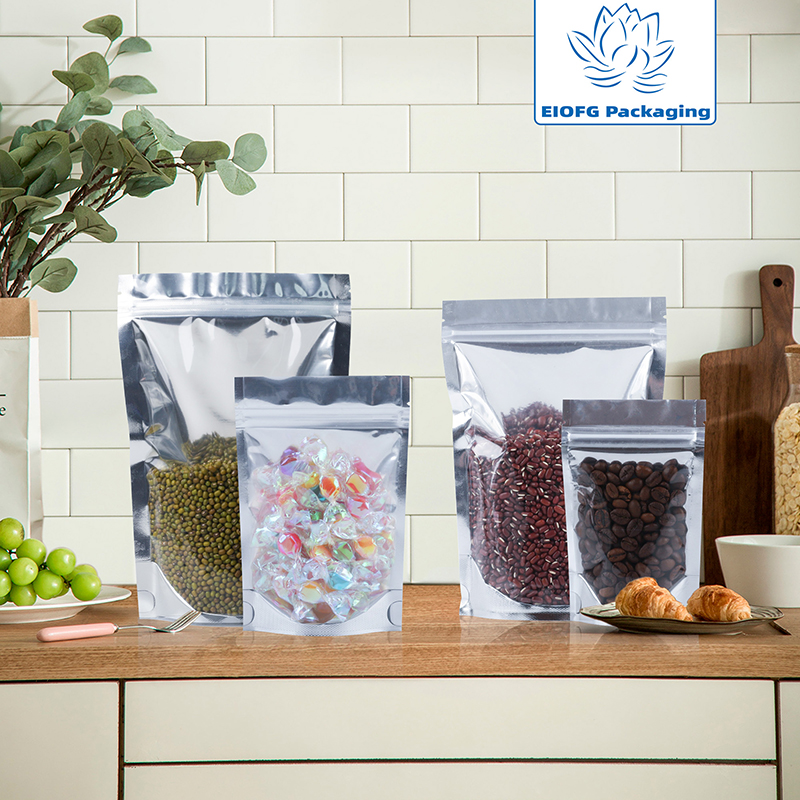
Oxygen and moisture degrade food quality rapidly. Define exact requirements for your oxygen transmission rate (OTR) and moisture vapor transmission rate (MVTR). Fresh meats require highly restrictive oxygen barriers to maintain their color. Conversely, freshly roasted coffee requires degassing valves to release carbon dioxide while blocking exterior air. When evaluating flexible formats like custom plastic food bags, check for multi-layer laminations. Factories often combine nylon for strength, aluminum foil for light blocking, and linear low-density polyethylene for internal sealing. These laminations prevent spoilage and dramatically extend shelf life.
Assess container impact resistance, warehouse stackability limits, and puncture resistance based on your exact logistics. High warehouse temperatures weaken rigid container walls over time, causing lower pallets to crush. Sharp food edges like dried pasta or rough handler loading can easily pierce weak films. Document these physical requirements clearly before requesting prototypes.
Subjective quality arguments waste time and money. Your objective is defining objective standards for "acceptable" versus "defective" units before production begins. This framework prevents massive bulk rejections upon delivery.
High-volume manufacturing naturally involves slight physical variations. However, you must control these deviations to ensure automated filling machines run smoothly. Agree on strict +/- percentage limits for container thickness, overall dimensions, and gram weight. If a rigid container falls below the minimum agreed gram weight, it will likely warp during a hot-fill process or collapse during pallet stacking.
A weak seal destroys product freshness and causes messy shipping leaks. For lidding films or zippered custom plastic food bags, require rigorous mechanical testing data. Request vacuum leak testing reports. Demand burst testing data, which simulates the severe pressure changes experienced during high-altitude truck shipping or air freight. These tests prove the seal holds up under stress.
Brand perception matters immensely on the retail shelf. Establish physical color targets using widely accepted Pantone matching books rather than digital mockups. Define acceptable deviation parameters. Use spectrophotometers to remove human bias from color checking.
Additionally, test ink adhesion rigorously. You must ensure branding does not rub off during transit vibration. It must also survive the heavy condensation common inside commercial refrigerators. Require your supplier to perform standard tape-peel tests on printed samples. This verifies the ink has properly cured to the plastic surface.
You must ensure the supplier remains economically viable and capable of scaling smoothly alongside your business. Relying entirely on the lowest quoted unit price hides massive backend risks.
Identify all upfront setup fees before engaging a new supplier. Custom mold tooling requires significant capital. Single-cavity prototype molds cost less but cannot support mass production. Multi-cavity production molds cost significantly more but lower the unit price. Also, identify printing plate fees and die-cut charges. Clarify exactly who pays for engineering revisions if the initial prototype fails your line test.
Calculate shipping and warehousing costs carefully. Evaluate the nesting efficiency of rigid containers. Poorly nesting bowls consume excess shipping volume, meaning you pay high freight rates just to transport air. Conversely, flat storage of flexible pouches offers massive freight savings. A single pallet of flexible pouches can replace an entire truckload of rigid tubs.
Factories impose minimum order quantities to justify machine setup times and material changeovers. Evaluate whether their MOQs align with your cash flow and inventory turnover cycles. Holding excessive stock ties up vital capital and increases the risk of damage during storage. If the MOQ is too high, negotiate split shipments. This lets you pay for and receive inventory in manageable monthly batches.
Clearly distinguish between different timeline categories. "First-run" lead times include structural engineering, physical prototyping, tooling creation, and sample approval. This entire process often takes several months. "Reorder" lead times skip the tooling phase and proceed much faster. Get both timelines codified in writing to prevent stockouts.
Your objective is locking in service-level agreements (SLAs) that legally and financially protect the buyer. An informal email thread is not a contract. Follow these specific guidelines when finalizing your partnership.
Sourcing reliable Plastic Food Packaging is essentially an exercise in comprehensive risk mitigation. Success relies on gathering verifiable safety data, enforcing objective quality standards, and establishing highly transparent upfront cost structures. Cutting corners on material testing or ignoring manufacturer audits frequently results in catastrophic product failures and damaged brand equity.
Take action by building a formal evaluation matrix utilizing the strict criteria outlined above. Request your first set of material safety data sheets today. Finally, demand physical prototype samples from your top three shortlisted vendors and run them through your facility machinery. Proper vetting requires patience, but it guarantees operational stability.
A: Typically ranges from 1% to 2.5% depending on the complexity of the custom mold or print. This must be codified in your Acceptable Quality Limit (AQL) agreement.
A: First-time orders often take 6-10 weeks due to structural engineering, mold tooling, and sampling. Subsequent reorders typically take 3-5 weeks depending on facility capacity.
A: Generally, yes. However, buyers must confirm in writing that they own the rights to the custom mold once it is paid for, preventing the manufacturer from using it for competitors.