


Author: Site Editor Publish Time: 18-08-2026 Origin: Site


Perfecting a recipe is only half the battle in commercial baking. Maintaining that exact texture from the cooling rack to the consumer's kitchen dictates repeat business. Improper packaging carries a heavy financial and reputational cost. Mismatched seal styles lead to accelerated staling, soggy crusts, or premature mold growth, directly impacting shelf life and retail viability. When a crisp artisan bread turns rubbery or a soft cookie dries out, brand trust erodes quickly. Selecting the right closure requires a technical evaluation framework. Operators must match packaging to product water activity (Aw), crust characteristics, operational throughput, and retail presentation requirements. Understanding how different closures interact with specific baked goods is essential for extending freshness, protecting structural integrity, and optimizing the packaging workflow.
Product-Seal Alignment: High-moisture goods (soft cookies, frosted cakes) require airtight heat seals, while hard-crusted artisan breads demand vented or semi-permeable closures to prevent moisture trapping.
Operational Scalability: Manual closures (stickers, fold-overs) offer low barrier-to-entry for micro-bakeries and cottage food operators, but automated heat sealing and mechanized twist ties are mandatory for high-volume consistency and labor reduction.
Material Synergy: The effectiveness of a seal is heavily dependent on the bag material (e.g., micro-perforated poly, cellophane, or kraft paper) and features like window bakery packaging, which must balance visibility with barrier integrity.
Cost vs. Shelf-Life Trade-off: Investing in higher-barrier seals and commercial sealing equipment yields a measurable ROI through reduced product waste and expanded wholesale distribution radiuses.
Defining the baseline metrics for packaging success starts with moisture control. Effective bakery bags must manage moisture retention to prevent drying and moisture release to prevent sogginess. Structural protection prevents delicate items from crushing, while oxygen barrier performance delays lipid oxidation and rancidity in high-fat goods. You cannot separate the quality of the bake from the physics of the package.
The internal moisture of a baked good constantly interacts with the ambient environment inside the packaging. This relationship is governed by water activity (Aw). Products with high Aw, like muffins and soft cookies, constantly release moisture. If the seal and material do not accommodate or contain this moisture appropriately, the product degrades rapidly. Low Aw products require protection from ambient humidity to maintain their crispness. When you put a high-moisture product in a highly permeable package, it turns into a brick. When you put a low-moisture product in a hermetically sealed package in a humid environment, it turns to mush.
Placing warm or high-moisture products into fully sealed, non-breathable environments without proper cooling protocols creates a severe condensation risk. As the product cools inside a hermetically sealed bag, moisture vapor condenses on the inner film. This trapped water falls back onto the product, instantly ruining crusts and creating an ideal breeding ground for mold. Operators must establish strict cooling parameters before sealing.
Verify internal product temperature reaches ambient room temperature (typically 68-72°F) before initiating the packaging sequence.
Measure the ambient humidity in the packaging room; high humidity requires faster sealing times post-cooling to prevent moisture absorption.
Utilize cooling racks with adequate airflow to prevent moisture pooling at the base of the product prior to bagging.
Conduct spot checks with a moisture meter on the crust to ensure surface water activity has stabilized.
Beyond moisture management, a robust seal provides vital physical protection. An airtight closure helps maintain slight bag inflation, creating a cushioning effect. This air pocket protects delicate toppings, frostings, and fragile crumb structures during transport, stacking, and retail handling, ensuring the product looks pristine upon purchase. A collapsed bag transfers all external mechanical stress directly to the pastry.
Baked Good Category | Typical Water Activity (Aw) | Primary Spoilage Risk | Required Seal Characteristic |
|---|---|---|---|
Artisan Sourdough | 0.95 (Crumb) / 0.70 (Crust) | Crust softening, mold | High permeability, vented closure |
Soft Cookies | 0.65 - 0.75 | Moisture loss, staling | Hermetic heat seal, high barrier |
Muffins & Pound Cake | 0.85 - 0.90 | Mold growth, condensation | Airtight seal with proper pre-cooling |
Biscotti & Crackers | 0.20 - 0.30 | Moisture gain, loss of snap | Absolute moisture barrier, heat seal |
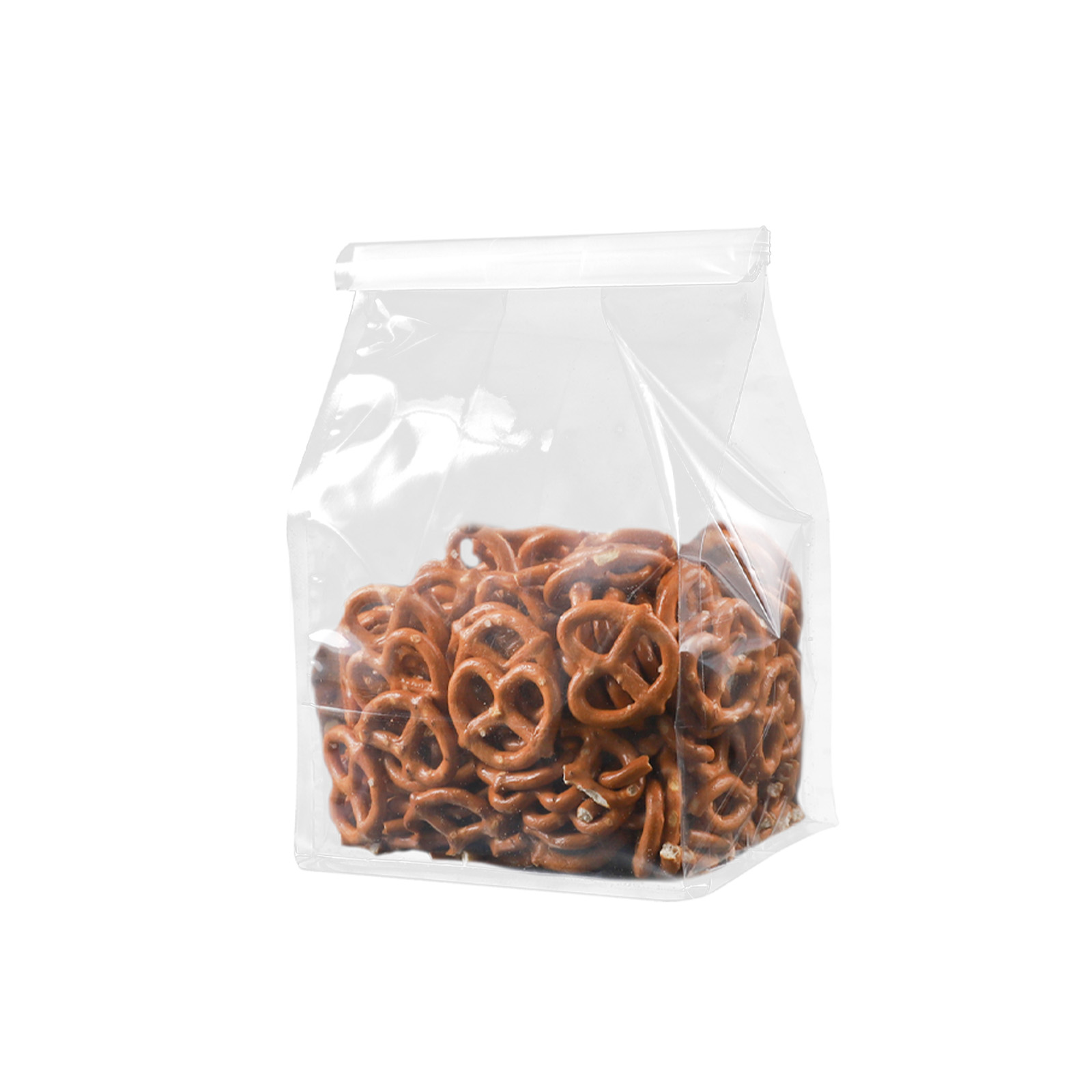
Heat sealing uses impulse, constant heat, or continuous band sealers to melt thermoplastic polymers together. This mechanism creates a fused, airtight barrier. It is best suited for thick bakery-style cookies, brownies, muffins, and products requiring maximum shelf-life extension. Heat sealing is highly compatible with polypropylene and cellophane materials, which melt cleanly under controlled thermal application.
The primary advantage is exceptional barrier protection and built-in tamper evidence. You know immediately if the package has been compromised. However, it requires an initial equipment investment and precise temperature calibration to prevent melting or warping the film. It also prevents consumer resealing unless a secondary closure, like a press-to-close zipper, is integrated into the pouch design. Operators must regularly replace the PTFE tape on impulse sealers to prevent the plastic from sticking to the heating element and causing channel leaks.
This closure method utilizes metal wire or plastic core ties applied manually or via semi-automatic tying machines around the gathered neck of a bread packaging bag. It is the industry standard for sliced sandwich bread, bagels, bulk rolls, and high-turnover fresh items. The mechanics are simple but highly effective for specific product categories.
A twist tie bakery bag is highly resealable for the end-user and extremely cost-effective. It provides a low-to-moderate oxygen barrier. This makes it ideal for daily staples but unsuitable for long-term ambient storage of sensitive, high-fat pastries that require strict oxygen exclusion to prevent rancidity. The wire gauge of the tie dictates the holding strength; heavier items require a thicker gauge to prevent the bag from opening during transit.
Tin ties feature integrated metal or plastic strips secured near the top of the bag. The user folds the top down multiple times and bends the tabs to secure the opening. This style is popular for coffee shop pastries, premium retail bags, dry cookies, and gourmet treats. The application requires a specific technique: fold the paper down tightly against the product to expel excess air before bending the tabs.
These closures offer a high-end artisanal aesthetic and are easily resealable. The downside is the moderate labor intensity required to apply them manually on the packaging line. Furthermore, the airtightness is inconsistent, depending entirely on how tightly the user folds and secures the tie. A loose fold allows rapid air exchange, defeating the purpose of the barrier material.
Peel-and-seal flaps use pre-applied adhesive strips with a peel-away backing built directly into the bag. They are best for individual retail portions, quick-turnover farmers market items, and grab-and-go cookies. The operator simply removes the liner and presses the flap down.
This method allows for rapid manual packaging speed and a clean presentation without requiring machinery. However, the adhesive can fail if exposed to ambient flour dust, grease, or high moisture environments, compromising the seal integrity. If your packaging environment has high airborne particulate levels, self-adhesive flaps will experience a high failure rate.
Maintaining a crisp crust requires moisture to escape. If moisture is trapped, the crust absorbs it and becomes rubbery. The solution involves using open-ended kraft paper bags, micro-perforated films, or loose twist ties. Airtight heat seals must be avoided entirely for crusty artisan breads. Micro-perforations allow a controlled moisture vapor transmission rate (MVTR), balancing crust crispness with crumb softness.
The goal here is preventing drying out while preserving delicate icing or soft textures. Cellophane bags with continuous heat seals lock in fats and moisture perfectly. For outdoor markets, heat sealing prevents ambient humidity from softening the cookies or causing sugar bloom on the icing. A wide-band heat seal provides the best visual presentation and structural security for heavy cookies.
These products require preventing moisture migration into the atmosphere and stopping premature mold growth. Polypropylene bags with hermetic heat seals provide the necessary barrier. The airtight environment keeps the crumb moist and extends the viable retail window significantly. Operators often use a gas flush (nitrogen) prior to heat sealing to displace oxygen and further inhibit aerobic mold growth.
Protecting structural integrity and aesthetics while maintaining freshness is paramount. Gusseted bags with rigid bases work best. Sealing these via tin ties or wide-band heat seals maintains structural air-pockets. This prevents the bag from collapsing inward and smudging the delicate frosting or glaze. The seal must be positioned high enough above the product to allow for this protective air volume.
Product Type | Recommended Seal Style | Avoid This Seal | Operational Reason |
|---|---|---|---|
Sliced Sandwich Bread | Twist Tie | Heat Seal (without zipper) | Consumers need easy resealability for daily use. |
Frosted Cupcakes | Tin Tie (Gusseted Bag) | Self-Adhesive Flat Bag | Requires vertical clearance to protect frosting. |
Baguettes | Open End / Micro-perf | Hermetic Heat Seal | Trapped moisture destroys the crust texture instantly. |
Brownies | Impulse Heat Seal | Loose Fold-Over | High fat content requires oxygen barrier to prevent rancidity. |
Consumers buy with their eyes, making visibility a powerful merchandising tool. However, windows add sealing complexity. Integrating a PLA or PET window impacts the overall barrier properties of the bag. The transition point between the paper substrate and the window film can be a weak point for moisture migration. If the adhesive holding the window fails, the entire package barrier is compromised.
Furthermore, bags featuring window bakery packaging often require specific heat-sealing temperatures. Operators must carefully calibrate equipment to secure the main seal without warping or melting the window film, which would ruin the presentation. A warped window looks unprofessional and often indicates a compromised seal nearby.
Kraft paper is highly breathable but offers a poor moisture and oxygen barrier. It pairs well with fold-over seals for short-term crusty bread storage. Poly and cellophane offer high barriers and are highly melt-friendly, making them perfect for heat sealing. You must match the seal mechanism to the substrate's thermal properties.
The chosen seal must complement the substrate's natural properties. Cellophane stands out as an eco-friendlier, heat-sealable alternative to traditional petroleum-based plastics, offering excellent clarity and barrier performance for premium baked goods. However, cellophane requires a lower sealing temperature than thick polypropylene; applying too much heat will scorch the material and create a brittle, easily broken seal.
Micro-bakeries and farmers market vendors typically rely on manual impulse heat sealers and self-adhesive bags. These tools are low-cost and highly portable. Mid-sized retail and commercial kitchens often transition to semi-automatic twist tie machines and continuous band sealers to handle increased throughput efficiently. A continuous band sealer allows an operator to feed bags continuously, drastically increasing units per minute.
Industrial production facilities require fully automated form-fill-seal packaging machines. These systems maximize speed, ensure absolute seal consistency, and minimize human handling errors across thousands of units per hour. Transitioning between these tiers requires careful planning regarding floor space, power requirements, and staff training.
Evaluating equipment requires comparing the labor cost of manually applying stickers or tin ties against the capital expenditure of automated machinery. An impulse heat sealer or automated twist-tie machine requires upfront investment but drastically cuts labor hours. You are trading capital for throughput.
Operators must define their volume threshold. When manual sealing becomes a bottleneck, it erodes profit margins. Upgrading equipment at this threshold yields a rapid return on investment through increased output and reduced labor costs. If your staff spends more than two hours a day manually tying bags, a semi-automatic tying machine will pay for itself within a quarter.
Inconsistent heat seals present a major risk. Burn-through from excessive heat or weak seals from insufficient dwell time lead directly to product spoilage. Mitigating this requires strict Standard Operating Procedures (SOPs). Operators must document exact dwell time, pressure, and temperature settings based on specific bag mil thickness and material types.
Calibrate sealing equipment daily using a thermocouple to verify actual jaw temperature matches the digital readout.
Perform a water submersion test on random samples to check for micro-leaks in the heat seal.
Establish a preventative maintenance schedule to replace heating elements and Teflon belts before they fail during a production run.
Train operators to recognize visual cues of a bad seal, such as puckering, milky discoloration, or incomplete fusion.
Packaging must utilize FDA-compliant materials. Wholesale and retail distribution often mandate tamper-evident closures to ensure consumer safety. The choice of seal also impacts labeling workflows; for example, continuous band sealers can often thermal-print batch numbers and expiration dates directly onto the heat-seal margin, streamlining compliance and traceability.
Audit your current product lineup and categorize items by water activity and required shelf life to determine the necessary barrier level.
Conduct a 7-day shelf-life test using sample bags and closures under real-world temperature and humidity conditions before committing to bulk orders.
Calculate your daily packaging labor hours to identify the exact volume threshold where upgrading to semi-automatic sealing equipment becomes profitable.
Develop and post clear Standard Operating Procedures (SOPs) at the packaging station detailing exact temperature and dwell time settings for every bag material used.
A: The best method involves using micro-perforations or loose closures like twist ties. These options allow excess moisture to escape, preserving the crisp texture of the crust while providing basic protection from ambient contaminants.
A: Standard kraft paper cannot be heat sealed on its own. It requires a thermoplastic inner lining, such as poly, PLA, or a specialized heat-sealable lacquer, to melt and fuse under the heat sealer.
A: Heat sealing offers a professional, airtight, and tamper-evident finish that protects pastries from outdoor humidity. Self-adhesive flaps are faster to package manually but offer less environmental protection and can fail if exposed to flour dust.
A: A twist tie drastically reduces airflow and moisture loss. It provides a moderate shelf-life extension, typically keeping standard sandwich breads fresh for 3-5 days, while remaining highly user-friendly for resealing.
A: Airtightness depends on the manufacturing quality of the window seams and the final closure method. If the window is properly fused to the bag material and the top is heat-sealed, the package can maintain a strong airtight barrier.


