


Author: Site Editor Publish Time: 26-08-2026 Origin: Site


Shifting from standard rectangular pouches to custom die-cut designs introduces significant structural complexities. You will quickly notice these challenges regarding seal integrity. Complex curves, sharp angles, and spout insertions create uneven pressure points during the thermal sealing process. Standard packaging principles rarely apply here. For high-risk applications involving liquids or aggressive chemicals, a compromised seal equals catastrophic product failure. You face costly recalls, messy leaks, and immediate brand damage.
We must treat shaped packaging as a unique engineering discipline. Packaging engineers and procurement teams require a concrete framework to navigate these risks. You need clear strategies for evaluating specific seal zones. You must identify material compatibility issues early. Furthermore, you must vet manufacturer capabilities rigorously before committing to an expensive tooling setup or a high-volume production run. This guide delivers actionable steps to protect your product and ensure flawless package performance.
Standard straight-bar heat seals apply uniform pressure across a flat plane. Custom dies behave differently. They must distribute heat and pressure evenly across varying radii and intersecting angles. Thermal dynamics change drastically when sealing jaws navigate curves. Heat tends to pool in tight corners. Meanwhile, wider curved sections might experience unexpected pressure drops. If your sealing equipment cannot dynamically adjust thermal profiles, you risk burning the film in one zone while under-sealing another. We constantly see structural failures stemming directly from unbalanced jaw pressure.
A crucial margin of error exists between the printed web, the thermal seal footprint, and the physical die-cut edge. We call this registration drift. Misalignment here rapidly reduces the effective seal width. A minor one-millimeter shift during high-speed production can push the die-cut blade into the seal area. This error weakens the perimeter margin and leads to blowouts. Standard pouches forgive minor shifts. Shaped designs punish them. Your supplier must utilize high-precision servo motors and photo-eye tracking to keep registration perfectly aligned.
Complex folds form tiny capillary channels within the seal area. Your inner sealant layer must melt and flow seamlessly into these micro-gaps. We refer to this action as "caulking." Standard polyethylenes often lack the melt-flow index required for complex shapes. If the sealant cannot caulk effectively, microscopic tunnels remain open. Air enters, and liquid escapes. You must specify materials possessing exceptional viscoelastic properties when heated to ensure absolute hermeticity.
Buyers must identify high-risk structural areas on their technical drawings. Never leave these zones to chance. Specify your requirements clearly to avoid unexpected failures in your custom shaped packaging bag.
This area remains essential for any shaped spout pouch. The transition zone demands absolute precision. The seal jaw must apply differential pressure to bond the flexible film securely to a rigid HDPE or PP spout. Too much pressure crushes the fitment. Too little pressure leaves gaps at the spout ribs. Operators must utilize uniquely contoured jaws tailored specifically to the fitment diameter. Standard flat jaws will fail here every single time.
Look closely at the transition point where the pouch shifts from two layers on the sides to four layers at the gusset fold. Thickness doubles abruptly. Thermal transfer rates change instantly at this intersection. We frequently observe pin-holing and flex cracking in these specific corners. The sealing jaw must deliver enough energy to melt four layers without scorching the adjacent two-layer sections. This requires specialized tooling reliefs and precise temperature control.
Sharp "V" shapes or tight internal cutouts create natural weak points. Product weight focuses intense stress on these areas during drops or rough transit. Asymmetrical designs shift liquid contents unpredictably, slamming into tight radii.
Common Mistakes in Die-Line Design:
Best practice dictates maintaining a continuous, uncompromised seal width. Always recommend minimum radius tolerances for all die-lines.
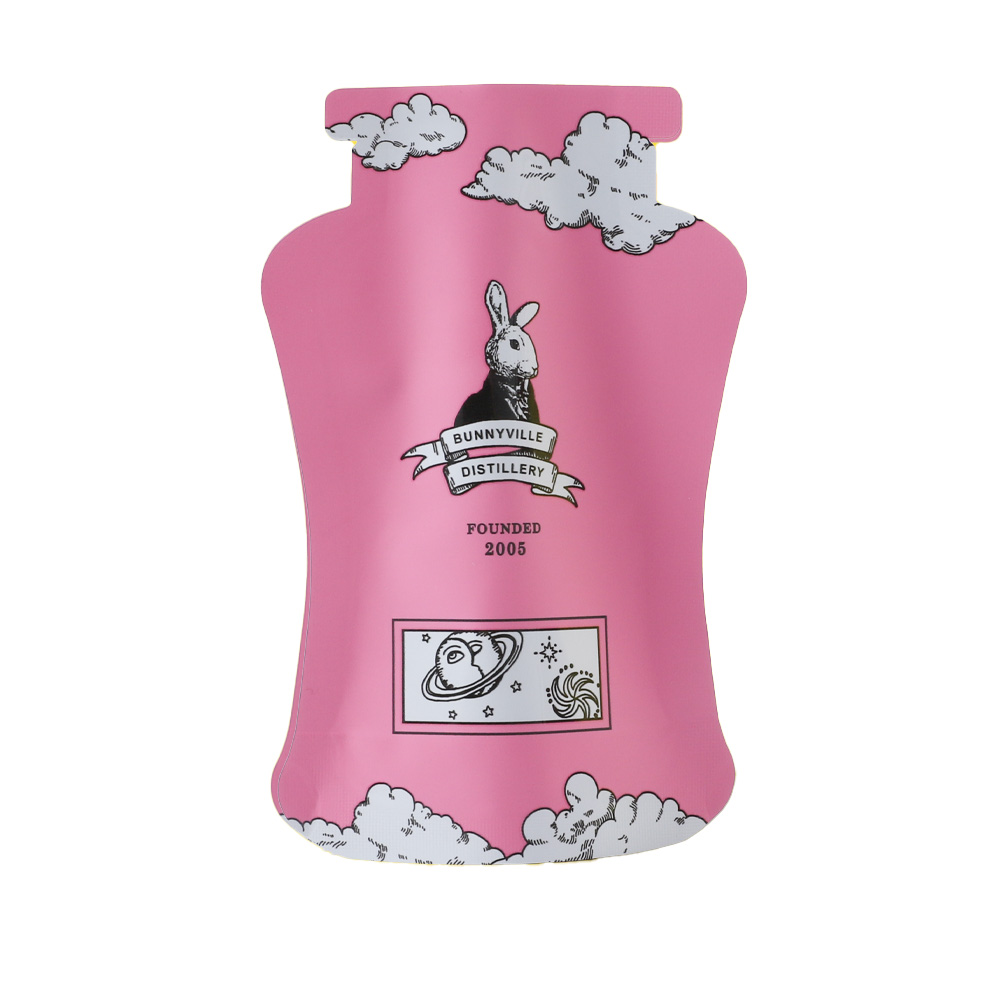
You must prioritize features-to-outcomes when engineering a shaped liquid pouch. Implementation realities dictate success or failure for demanding product fills.
Standard Polyethylene (PE) often struggles with complex geometries. We strongly recommend comparing standard PE against specialized Metallocene (mPE) or Cast Polypropylene (CPP). Metallocene offers a significantly lower seal initiation temperature. It provides superior hot-tack strength, meaning the seal grabs quickly before the package cools. CPP delivers excellent heat resistance and clarity. Your choice dictates how well the web handles stress immediately after the seal jaws release.
| Material Type | Seal Initiation Temp (SIT) | Hot-Tack Strength | Caulking Ability |
|---|---|---|---|
| Standard LLDPE | Medium | Moderate | Average |
| Metallocene (mPE) | Low (Faster Sealing) | Excellent | High |
| Cast Polypropylene (CPP) | High | Good | Moderate (Rigid structure) |
Aggressive fills severely degrade seal integrity over time. Surfactants, essential oils, and acidic beverages attack the sealant web. If the film stretches thin across a complex curved seal, it becomes highly vulnerable. Chemical resistance matters deeply here. A weakened corner seal will delaminate weeks after production. Always conduct extended shelf-life testing using the exact liquid formula to verify chemical compatibility.
You face a strict tradeoff between barrier protection and production speed. Thicker laminations improve barrier properties substantially. However, thick foils or heavy PET layers require longer dwell times. Heat takes longer to transfer through thick exterior layers to reach the inner sealant. This reality slows down overall production speeds. Attempting to speed up the machine by merely cranking up the heat usually causes exterior film scorching. You must balance gauge thickness against your desired output rates.
You must carefully evaluate scalability, adoption risks, and operational strategy. The manufacturing method directly impacts your final seal quality.
Procuring a reliable shaped pouch requires intensive vendor vetting. You must demonstrate trustworthiness through rigorous evaluation frameworks.
Never assume a manufacturer possesses the correct equipment. Ask them directly if they use dedicated custom seal jaws matching your exact die-line. Some vendors attempt to cut costs by using generic oversized jaws. This shortcut inevitably causes severe film warping around the edges. It also applies uneven pressure to critical transition zones. Demand photos of the tooling or require a factory audit to confirm they build dedicated jaws for your specific project.
Require concrete evidence of continuous, inline testing. A robust Quality Assurance program separates reliable partners from risky ones. You must verify three specific ASTM standards:
Request their Acceptable Quality Limit (AQL) specific to custom shapes. Standard pouches might carry a generous AQL. Complex geometries require much tighter tolerances. A reputable manufacturer will transparently discuss their defect rates and explain how their inline vision systems reject misaligned seals before they reach the shipping carton.
The viability of a custom shaped pouch hinges entirely on three interconnected factors. The marriage between the die-line geometry, the chosen sealant material, and the precision of the thermal tooling determines your success. You cannot compromise on any of these elements without risking severe structural failure. Complex designs demand rigorous engineering oversight from concept to final production.
Take immediate action to safeguard your investment. Before committing to high-volume production or paying expensive tooling fees, request unprinted prototype pouches. Ensure they use the exact specified lamination and geometry. Subject these prototypes to rigorous burst and drop testing using your actual product fill. Only move forward when the data proves the seal zones can withstand real-world supply chain abuse.
A: While standard pouches often use a 5mm to 8mm seal, complex shaped pouches—especially liquid applications—typically require a minimum 8mm to 10mm perimeter seal to account for die-cut shifting and pressure variance.
A: No. Materials with low puncture resistance or poor thermal transfer (like certain overly thick foil structures without proper sealant webs) will fail around the rigid spout integration. Always specify high-caulk inner webs.
A: Yes. Symmetrical, rounded designs distribute internal pressure evenly. Asymmetrical designs or shapes with sharp interior angles act as stress concentrators, significantly lowering the overall burst threshold of the package.


