


Author: Site Editor Publish Time: 19-08-2026 Origin: Site


Transitioning to or optimizing automated packaging lines requires precise synchronization between mechanical systems and packaging materials. Even minor material inconsistencies compound into significant operational losses at high speeds. Procurement and operations teams frequently face machine downtime, high scrap rates, and compromised seal integrity. These issues stem from misaligned specifications between automated machinery, like Vertical Form-Fill-Seal (VFFS) or Horizontal Form-Fill-Seal (HFFS) systems, and the selected rollstock.
This guide provides a technical framework for evaluating food packaging roll film. We analyze how material composition, manufacturing precision from resin to roll, and machine compatibility impact throughput and product safety. By understanding the mechanical demands of automated filling, plant managers can eliminate bottlenecks, reduce web breaks, and ensure reliable, high-speed production runs on the factory floor.
Machine-Material Synchronization: High-speed automated filling (VFFS/HFFS) demands specific tensile strength, slip coefficients, and hot tack properties to prevent web breaks and seal failures.
Barrier vs. Machinability Trade-offs: Selecting a food grade plastic film roll requires balancing necessary barrier properties (oxygen/moisture) with the flexibility and thermal tolerance required by automated sealing jaws.
Registration and Sensor Accuracy: Printed rollstock for food must feature precise eye marks and consistent web tension to ensure accurate cutting and forming without sensor faults.
Upstream Manufacturing Precision: The physical performance of the film on the packaging line is dictated by upstream extrusion, lamination, and slitting accuracy.
Risk Mitigation via Trials: Successful implementation mandates rigorous machine trials to validate thermal operating windows and trackability before full-scale deployment.
Automated filling relies on a continuous supply of laminated plastic or composite material. The film unwinds from a central core, passes through tension control arms, and travels over forming collars before being filled and sealed. The physical properties of the film directly dictate how smoothly this process occurs without tearing, stretching, or jamming the machinery. Operators must monitor web tension constantly. If the tension is too high, the film stretches, distorting printed graphics and throwing off eye-mark registration. If the tension is too low, the film wanders, causing crooked seals and machine jams.
In VFFS applications, products are gravity-fed into a tube formed by the packaging material. The sequence typically involves creating a vertical seal to form the tube, followed by a bottom horizontal seal. Immediately after this bottom seal is formed, the product drops into the pouch. This action requires exceptional hot-tack strength. Hot-tack is the ability of a seal to withstand stress while still hot and in a molten state. If the hot-tack strength is insufficient, the weight of the dropping product will rupture the bottom seal. This leads to product loss, machine contamination, and extended downtime for cleaning.
Machine operators must calibrate the sealing jaws to match the film's specific thermal profile. The dwell time—the exact fraction of a second the jaws clamp the film—must be long enough to melt the inner sealant layer but short enough to prevent burning the outer structural layer. High-speed VFFS lines push these limits, requiring films with broad thermal operating windows.
HFFS machines load products horizontally using pusher mechanics. They are ideal for solid items like baked goods, trays, or candy bars. The primary metric here is the Coefficient of Friction (COF). The film must possess the correct slip properties to glide smoothly over forming plates and folding shoes without sticking or dragging. Too much friction causes the web to stretch and misalign. Too little friction causes the drive belts to slip, losing registration and timing.
Static electricity also plays a major role in HFFS operations. As the film drags across metal components, static builds up, causing the film to cling to the machine or repel the product. Anti-static additives in the film formulation help mitigate this issue, ensuring smooth transit through the forming section.
Thermoforming involves heating a bottom web of film until pliable, drawing it into a cavity using vacuum or pressure, loading the product, and sealing a top web over it. This method is heavily utilized for dense, shaped products such as meat, fish, poultry, and cheese. Success depends on the film's memory, draw depth capabilities, and puncture resistance.
The material must stretch uniformly into deep-draw cavities without excessive thinning. Thinning leads to blowouts or compromised barrier properties. Operators must monitor the heating plates to ensure uniform temperature distribution. Cold spots on the heating plates cause uneven stretching, resulting in rejected packages.
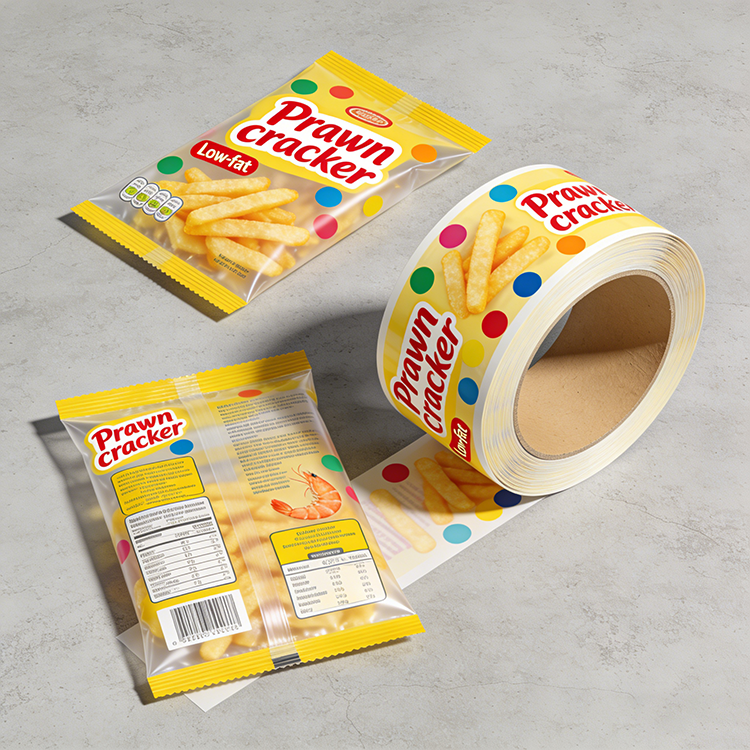
The performance of any flexible material on an automated line traces back to its manufacturing origins. Understanding how a film is constructed helps operators troubleshoot line issues and select the right specifications for their unique machinery. You cannot fix a bad roll of film with machine adjustments. The material must be manufactured to strict tolerances from the start.
Film quality begins with resin selection and the extrusion process. Gauge consistency during extrusion ensures the film lays flat and unwinds evenly. Variations in thickness cause soft spots or hard bands on the finished roll. These defects lead to erratic web tension on the packaging line. Precise roll slitting is also mandatory. Uneven edge slitting or improper winding tension creates edge curling. Edge curl causes the film to wander off the forming tube and trigger sensor faults.
When auditing a supplier, check their slitting tolerances. A tolerance of +/- 1mm is standard for high-speed applications. Anything looser will cause tracking issues. Additionally, verify the core quality. Crushed or out-of-round cores cause the roll to bounce on the unwind shaft, creating tension spikes that snap the web.
Most high-performance applications require multi-layer structures to combine different functional properties. A typical structure includes an outer structural layer for heat resistance and printability, a middle barrier layer to block oxygen and moisture, and an inner sealant layer designed to melt at specific temperatures.
Film Structure | Typical Materials | Primary Advantages | Best Automated Applications |
|---|---|---|---|
Monolayer | PE, CPP | Cost-effective, highly flexible, simple sealing profile. | Basic flow wrapping, low-barrier requirements, fresh produce. |
Multi-Layer Laminated | PET/ALU/PE, BOPP/EVOH/PE | Superior barrier properties, high puncture resistance, excellent printability. | High-speed VFFS, MAP packaging, thermoforming, perishable goods. |
Metallized Films | VMPET, VMCPP | Excellent light and moisture barrier, lower cost than foil. | Snack foods, coffee, dry powders. |
Automated machines utilize high-speed pull belts to advance the film. The material must possess adequate tensile strength to resist snapping under this sudden mechanical stress. Elongation properties dictate how much the film will stretch before breaking. If a film stretches too much under tension, the printed eye marks drift out of alignment. This causes the cutting knives to slice through the printed graphics or the product itself.
Achieving a hermetic seal requires balancing jaw temperature, pressure, and dwell time against the machine's speed. The inner sealant layer must have a low initiation temperature to melt quickly during short dwell times. The outer structural layer must withstand the heat of the sealing jaws without burning, melting, or sticking to the metal components. Operators use Teflon tape on the sealing jaws to prevent sticking, but a film with a narrow thermal window will still cause problems.
Different food categories impose unique demands on the packaging material. Selecting the right specification prevents spoilage and ensures maximum throughput on the packaging line. You must match the film to the specific product characteristics and the machine's capabilities.
Baked goods require a delicate balance of moisture retention and breathability. Using bakery packaging roll film engineered with micro-perforations prevents condensation. Condensation leads to mold, while too much breathability makes the product stale. For automated flow wrappers, these films frequently feature anti-fog properties and high-clarity display windows. Customizing the roll width precisely to the machine's forming collar eliminates excess trim waste on high-speed lines.
Meat, dairy, and prepared foods rely on Modified Atmosphere Packaging (MAP) to extend shelf life. This requires films with strictly controlled Oxygen Transmission Rates (OTR) and Moisture Vapor Transmission Rates (MVTR). During automated gas-flushing, the film must maintain structural integrity and form a flawless hermetic seal. Any micro-leaks in the seal will allow the protective gas mixture to escape, leading to rapid product spoilage.
Visual branding is essential, but the printing process must not interfere with machinability. High-quality printed rollstock for food utilizes reverse printing techniques. Reverse printing places the ink on the inside of the outer layer before lamination. This protects the inks from scuffing as the film drags over metal forming collars at high speeds. Precise eye-mark placement and high contrast ratios are mandatory for photo-eye sensors to register cuts accurately.
Procurement decisions must look beyond the initial invoice price of the material. You must evaluate how the film's specifications impact the entire production ecosystem. Cheap film often costs more in the long run due to machine downtime and wasted product.
Downgauging involves using a thinner food grade plastic film roll to save on upfront material costs. This strategy often backfires on the production floor. Thinner films are more susceptible to stretching, tearing, and heat damage. The savings gained from purchasing less plastic are quickly erased by increased machine downtime, higher scrap rates, and the labor costs associated with constantly re-threading the machine.
Transitioning to mono-material or compostable films presents significant technical challenges on legacy machines designed for mixed-plastic laminates. Sustainable films often have narrower thermal operating windows. Because the entire structure is made of the same material family, the outer layer is prone to melting at the same temperature required to seal the inner layer. Running these materials successfully usually requires machine modifications, such as upgrading to specialized seal jaws with highly precise temperature controls.
Consistent film specifications drive reliable scheduling. When operators know the film will perform identically from roll to roll, they lock in machine settings rather than constantly tweaking tension and temperature. This repeatability leads to predictable throughput, lower scrap rates, and more accurate fulfillment of production quotas.
Deploying new rollstock on an automated line introduces several mechanical and compliance risks. Identifying these early prevents large-scale production failures. You must test materials rigorously before committing to large orders.
When film wanders off the forming tube, the result is crooked seals, off-center prints, or completely open packages. This is often caused by uneven roll winding or incorrect core sizes. To mitigate this, facilities should utilize automated web-guiding systems and verify core dimensions before loading. Audit the supplier's slitting precision during the qualification phase.
Micro-channels in the seal area, particularly where gussets or overlapping folds occur, compromise product safety. These leakers are often invisible to the naked eye. Mitigation requires conducting rigorous burst testing and dye penetration tests during the machine trial phase. Operators must fine-tune jaw pressure, temperature, and dwell time until a consistent, flawless seal is achieved across all layers of the film.
The migration of inks, solvents, or chemical additives from the packaging into the food product poses severe health and legal risks. To prevent this, procurement teams must mandate comprehensive documentation from the film supplier. This includes Letters of Guarantee (LOG), FDA or EFSA compliance certificates, and proof that the manufacturing facility holds GFSI-recognized certifications.
Automated filling efficiency depends entirely on the structural, mechanical, and thermal compatibility of the chosen rollstock with the specific packaging machinery. A misalignment between film properties and machine mechanics results in unavoidable downtime and product waste. To ensure a successful deployment, operations teams should execute the following steps.
Request detailed Technical Data Sheets (TDS) for all shortlisted materials to verify tensile strength, COF, and sealing temperatures.
Procure sample rolls to conduct controlled machine trials, specifically validating hot tack strength, slip performance, and seal integrity under actual production conditions.
Perform burst testing and dye penetration tests on trial packages to confirm hermetic seal integrity across various machine speeds.
Audit the supplier's manufacturing tolerances regarding gauge consistency and slitting precision before finalizing vendor contracts.
A: Roll film is a continuous web of material formed, filled, and sealed by the machine in one fluid process, offering higher speeds and lower per-unit material costs. Pre-made pouches are already formed and only require filling and sealing, which is slower but allows for more complex pouch shapes and simpler machinery.
A: The correct COF depends on the machine type. HFFS machines require a lower COF (higher slip) so the film glides easily over horizontal forming plates. VFFS machines may require a slightly higher COF to ensure the drive belts can grip the film securely without slipping during the downward pull.
A: Registration loss occurs when the film stretches under tension, altering the distance between printed eye marks. It can also be caused by low-contrast eye marks that the photo-sensor fails to read, or by drive belts slipping due to an incorrect coefficient of friction on the film's surface.
A: Inconsistent thickness (gauge variation) during extrusion creates uneven tension across the web. This causes the film to track poorly, wander off forming collars, and create weak spots in seals where the material is too thin to bond properly under the jaws.
A: While the barrier properties might be suitable for both, the mechanical specifications must be tailored. VFFS requires high hot-tack strength for vertical drops, whereas HFFS requires specific slip properties for horizontal dragging. A single film rarely performs optimally on both without specific engineering adjustments.
A: Hot tack strength determines how quickly a newly formed bottom seal can support the weight of the dropped product. If the hot tack is strong, the machine can run faster because it requires less cooling time before the product impacts the seal.
A: Standard core sizes are typically 3 inches (76mm) or 6 inches (152mm) in diameter. Maximum roll diameters vary strictly by machine model, usually ranging from 12 to 24 inches. Exceeding the maximum diameter or weight limits will overload the machine's unwind motor and tension control arms.


